
Years ago in the tech sector, I watched our team lose an opportunity we had no business losing.
Our team had spent months building a bold partnership in an emerging market that was growing quickly and aligned perfectly with our long-term strategy. We had enough information to move. The risk was reasonable. The upside was tremendous.
But instead of approving the decision, leadership asked for another round of analysis. And then another. And then another.
Market sizing. Sensitivity models. Scenario simulations. Competitive overlays. Every round told the same story. Move now.
But the data never felt complete enough. They kept waiting for certainty.
And while we waited, our competitor did not. They moved first. They secured the partnership. They became the embedded player in a market we could have led. And we spent years trying to catch up.
That moment taught me something I now see everywhere. A lack of information does not paralyze leaders. They are paralyzed because they have too much of it.
Of course, the opposite failure mode exists. Reckless speed destroys companies as quickly as over-analysis. The point is not to go faster. The point is knowing when you have enough clarity to move responsibly and when waiting is actually the bigger risk. That discernment is becoming one of the rarest leadership skills of our time.
When Information Becomes a Trap
In a recent conversation on my podcast, Dr. Barbara Whye told me something that has stayed with me ever since. The best leaders today learn and unlearn.
It struck me because unlearning is not about forgetting. It is about releasing the mental model that more data always equals better decisions. That belief served us well in the industrial age when measurement and optimization ruled. But in today’s environment, where speed and complexity define the landscape, that old model is not just outdated, it is actively harmful.
We have built a business culture that treats discomfort as a sign of poor leadership instead of a normal part of it. Dashboards generate confidence. AI generates articulate answers instantly. Forecasting tools create the illusion that uncertainty can be eliminated if we just look hard enough.
It becomes easy to believe that leadership should feel like querying a machine. Fast. Clean. Confident. Complete.
But the decisions that truly shape the future rarely offer that kind of clarity. Decisions about innovation, people, values, timing, and direction require something that data alone cannot deliver. They require the ability to read the room rather than just the report. They require trusting your instinct when the numbers remain inconclusive. They require knowing when good enough data is actually enough.
This is not permission to ignore data. It is a reminder that data describes the world we already know, not the world we are about to create.
The Turning Point
For most of human history, uncertainty was simply normal. Leaders did not enjoy it, but they accepted it.
Then AI arrived with extraordinary speed and changed something subtle but profound. It reshaped our expectations for how quickly clarity should arrive. Ask a question. Get an instant reply. The response is clean and confident, even when the underlying reality is anything but.
Quietly and almost invisibly, this rewired how many leaders engage with ambiguity. We began expecting strategic decisions to feel as frictionless as interacting with an AI model.
But AI did not eliminate ambiguity. It only made us less practiced at navigating it.
The danger is not that technology exists. The danger is believing that leadership should feel as immediate and tidy as the answers it provides.
The Real Problem Is Not Just Leaders. It Is the System.
Many leaders hesitate not because they lack courage, but because their organizations punish bold moves and reward safe paralysis. You can have the sharpest intuition in the world, but if your culture penalizes you for being wrong, you will wait for certainty every time.
This is not just a mindset issue. It is an incentive issue.
But even when leaders cannot change the system overnight, they can change how they move within it. And very often the system only begins to change because someone decides to act before the rest of the organization is ready.
The New Leadership Divide
The real divide today is not between leaders with access to data and those without it.
It is between leaders who can act without perfect clarity and leaders who are waiting for a level of certainty that no longer exists in the modern world.
The leaders who shape the next decade will be the ones who move when others hesitate. They will act before consensus forms. They will trust their informed intuition rather than their ego. They will create clarity through motion rather than analysis. They will sense patterns that the dashboards cannot yet articulate.
Anyone can lead with a script. The future belongs to leaders who can lead when no script exists.
A Framework for Deciding Without Certainty
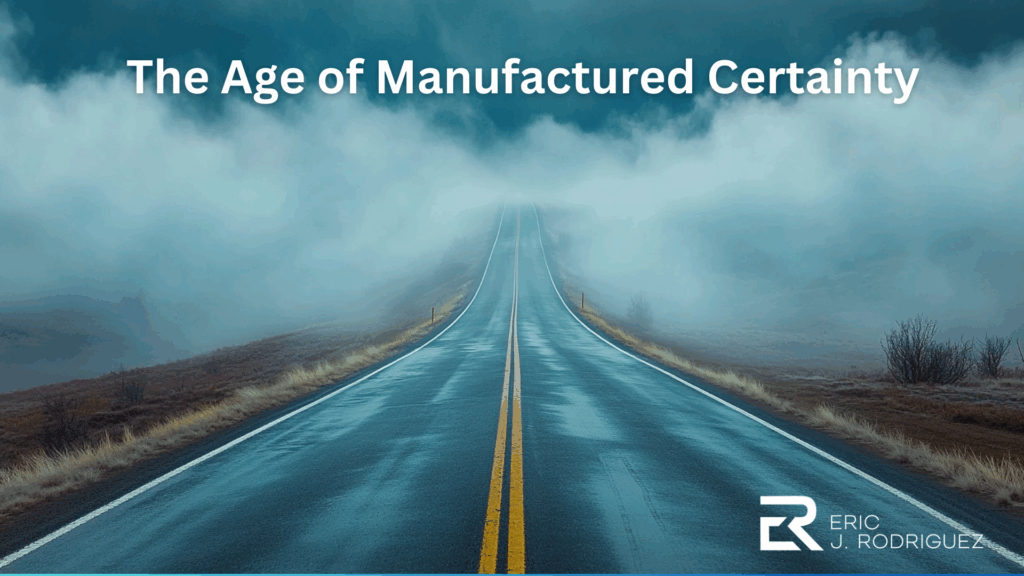
Here is a simple method for making movement possible even when the path is foggy, without crossing into reckless action.
Define the Minimum Knowable
Write it down. Literally. Identify the two or three questions that must be answered before it is responsible to act. Not every question. Only the essential ones. This alone reduces both over-analysis and impulsive decisions.
Choose the Smallest Reversible Step
Not a leap. A test. If the question is whether you should enter a new market, the reversible step is a thirty-day pilot that will show you what the data cannot.
Set a Decision Deadline Before You Feel Ready
Waiting for more data often becomes procrastination disguised as professionalism. Seventy percent clarity is usually not only enough but optimal.
Ask the Question AI Cannot Answer
What does the data not yet know? This is where leadership begins. Not ego intuition. Not impulse. Pattern-recognition intuition. The kind of only lived experience can teach you.
The Human Advantage
AI will become faster. Models will become sharper. Data will become louder. But none of those tools can replace the uniquely human capacity to make decisions before the picture is fully clear.
The human advantage is not certainty. It is courage guided by judgment.
The leaders who thrive in the Age of Manufactured Certainty will be the ones who can say: I see enough to take the next step, and taking the step is what will create the clarity I am waiting for.
So I leave you with a question.
What decision are you waiting for certainty on that actually requires courage? And what clarity might appear if you took the first step tomorrow?
If this reflection resonated with you, I invite you to join my newsletter, where I share more insights on leadership, humanity, and the future of the human experience. Let’s continue the conversation and build something meaningful together.