
You can spend years thinking you understand presence and still miss the moment that taught you what it is.
I was at 5,500 feet, climbing the Red Rocks stairs with a 25-pound goruck on my back, when Sterling Hawkins said something that stopped me. He had been talking about why most people never tap their actual capacity. Our minds tell us to stop, he said, when we are only 30 percent of the way there. Seventy percent of who we could become stays inside, unused, while we tell ourselves we are tired.
But that was not the moment. The moment came later, when we were already off the trail.
The Two Stories That Run Our Lives
There are two stories most people live in.
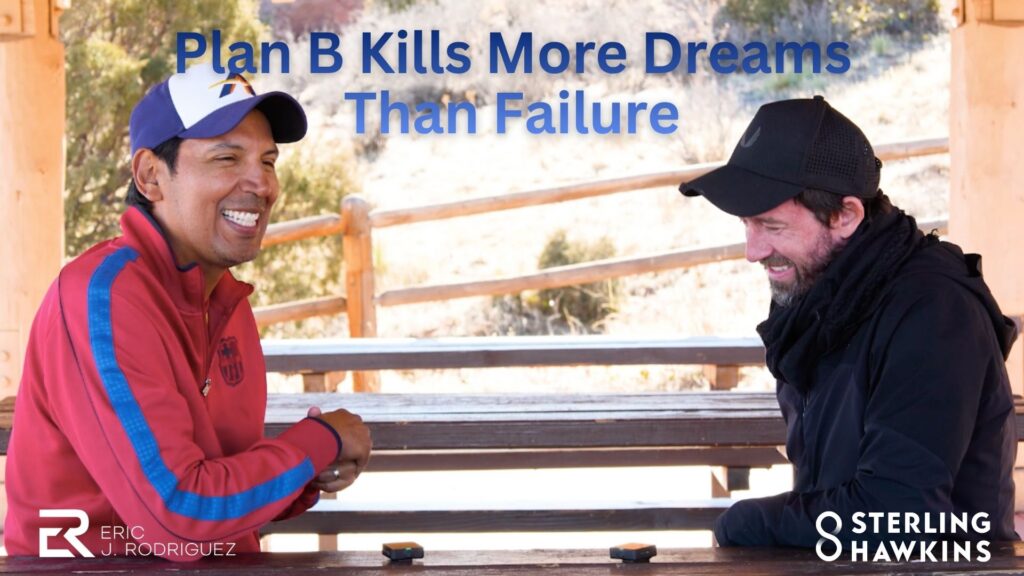
The first is the story of Plan B. The safety net. The path back to who you used to be, if this version does not work. Plan B is dressed up as wisdom. As prudence. As taking the smart bet. Sterling has a different word for it. He calls it the easy out. He thinks Plan B kills more dreams than failure does, because failure forces a confrontation and Plan B never does.
The second is the story of why you cannot fully show up. You have responsibilities. You have a five-year plan. You have an identity built around being a certain kind of person — the data person, the strategic person, the rational person — and that identity has gotten you here. You sacrifice this moment, Sterling told me, for the one that you may never have.
Most of us are running both stories at once.
The Moment I Did Not See Coming
A few weeks before I flew to Denver, I was sitting in the school parking lot, reading Because of Winn-Dixie aloud to my daughter.
I had dropped her brother off. We had fifteen minutes before her school day started. So we read together in the car. She follows along while I read aloud. We have done this with two books. We are in the middle of the third.
That morning, the book hit a scene that opened me up. Not because of what was on the page. Because I realized: she is never going to forget this. Not the book. The fact that her dad read it to her.
I started to cry in the car, holding a children’s book, with my daughter watching me. She thought I was crying because of the story. I was not. I was crying because we had built something I did not plan for and could not have scheduled. A core memory. The kind that ten years from now will be the thing she remembers about me.
When I was in corporate, I used to want my kids to leave on time so I could get back to work. The drop-offs were a logistics problem. They were not the moment.
Sterling has a phrase for what these are. He calls it the joy of the unplanned.
What This Has to Do With Leadership
I tell leaders all the time that the future is more human. I mean it. But I also notice how often I show up on stage with data, case studies, and research instead of the things that actually moved me.
That is a kind of Plan B, too. A different version of the safety net. We hide behind expertise because the alternative — saying what is most true for us out loud — feels exposed.
The leaders I admire most are the ones who have stopped doing that. Who has made the trade of credibility for connection? Who has figured out that the audience does not need more information? It needs to know who you are.
And One More Thing About Plan B
This is also why most AI rollouts stall.
Not at the technology. The technology part is mostly working. Your vendors are good. Your engineers are good. The integration runs.
It stalls at the seam where it meets human beings.
The middle manager who quietly hedges. The director who hides behind data. The CHRO, who knows the productivity number has not moved and cannot quite say why. The whole organization has built a safety net inside the rollout, a way to retreat to how it always did things if the change feels too risky. The pilot that never scales. The training that is attended but is not applied. The capability that the budget bought, and the workforce never picked up.
That is Plan B. Dressed up as prudence. Sold to the board as risk management. Costing the rollout the one thing it most needs: the people closest to the work showing up fully.
The leaders I am working with this year are doing something different. They are naming the Plan B in the room. They are letting their teams know that this is the version of the company they intend to build, and there is no easy out. It is the hardest version of leadership I have watched in twenty years. It is also the version that works.
What I Am Carrying Down From the Mountain
I left Red Rocks with a few things. A water bottle that says No Matter What on it. A T-shirt. A throat slightly raw from a ceremonial practice, Sterling brought back from the Shipibo in the Amazon, which is a story for another day.
But the thing I am actually carrying is the question Sterling kept returning to. In different forms. With different setups.
What are you 30 percent into and ready to quit?
What part of your life is built around a Plan B that has already started to cost you?
When was the last time you let yourself be moved in a way you did not schedule?
If you have a Plan B that lets you escape what is actually calling you, you might want to look at it. You might want to ask whether it is the safety net you say it is, or the reason you keep stopping at 30 percent.
The conversation I had with Sterling is the most unique episode we have ever produced. It is now in your podcast feed and on YouTube.
You can find your safety net any day. The other path is harder. It is also the one that takes you somewhere.
If you enjoyed this post, continue exploring with: AI Mistakes Leaders are making right now.
Listen to the full conversation with Sterling Hawkins on your favorite platforms:
Spotify
Apple
YouTube
Stay connected with the work Sterling is leading around the world. One of the most thoughtful leaders in our space today.