
Most workforce plans are built on a three-year horizon. Most jobs no longer change on a three-year horizon.
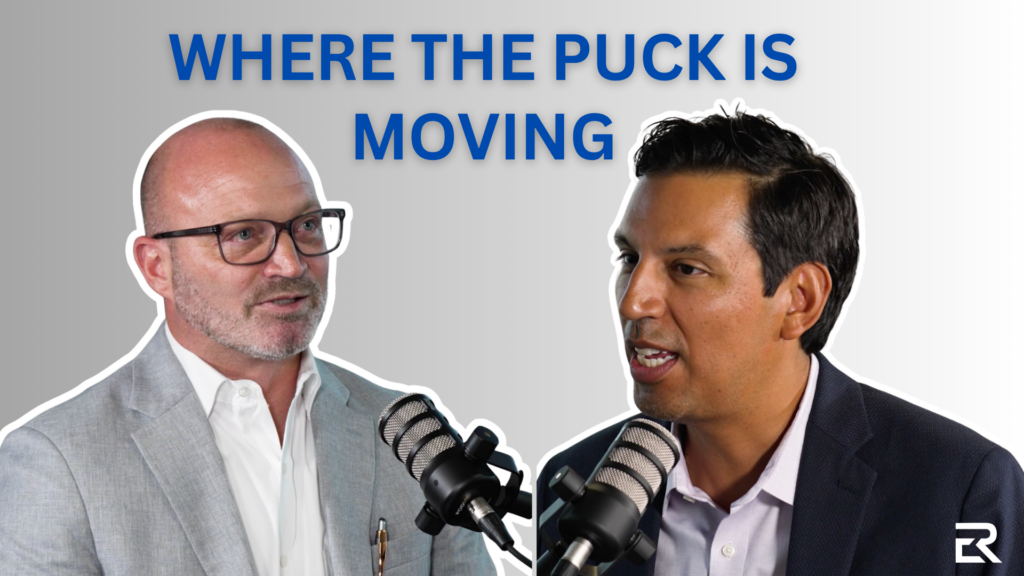
I sat down last week with Jason Weinstein, from Maricopa Community Colleges, for our latest episode of Future of Human Experience. Jason runs Maricopa Corporate College, the corporate-engagement arm of the largest community-college system in Arizona, which means he monitors the rate of skills change within actual companies in real time. What he is seeing is the thing every CHRO already feels but hasn’t fully said out loud:
The cycle is now faster than the plan.
Jason has a line for it. He said it about ten minutes in, almost as an aside:
“We have to be where the puck is moving, not where it is now.”
I wrote it down. I’ve been turning it over for two days. Because if you take that one sentence and apply it to your hiring funnel, your job descriptions, your internal-mobility program, and your learning-and-development budget, most enterprises are still skating to where the puck used to be.
Here’s what I mean.
THE 200-DAY OPEN REQUISITION
Jason told a story I cannot stop thinking about. He had been at an event the night before with a room full of HR leaders. One of them mentioned a requisition that had been open for over 200 days. They had interviewed candidates. The candidates had everything on paper. The hiring manager kept saying something didn’t sit right.
Two hundred days.
Here is the part that should make every CHRO sit up: the job description was the bottleneck. Not the candidate pool, not the recruiter, not the budget. The job description was written for a role that no longer exists as it once did. The company was looking for a unicorn against an old definition, while the work itself had quietly evolved.
Jason gave a second example that makes the same point in 30 seconds. He has seen job postings titled “engineer,” requiring five years of experience and a bachelor’s degree, offering 18 to 20 dollars an hour. He looks at the actual skills required, and it’s not an engineering role. It’s a technician role. The certificate exists. The candidate pool exists. The company is filtering itself out of its own market.
WHAT THE SYSTEM ACTUALLY LOOKS LIKE WHEN IT WORKS
The team at Maricopa Community Colleges has been building something that I think every CHRO should understand: a stackable system of on-ramps and off-ramps across an entire career.
A worker enters through a short-term fast-track program. Their employer offers tuition assistance. They earn an 18-credit certificate that maps to a real promotion. They go back to work, build skills, and come back later for the next certificate—eighteen more credits. By the time they have stacked four certificates, they have an associate’s degree — and a career path they designed in conversation with their employer.
That is not a benefit. That is a retention strategy. That is also what “future-proofing the workforce” looks like operationally, rather than as a slide title.
And here is the line that I want every CHRO to hear. Jason said it almost reluctantly, because he didn’t want to throw anyone under the bus:
“There is an underinvestment in the frontline workers more often than there is in the supervisory level workers.”
Every enterprise I have ever worked with has a leadership-development budget. Very few have an equivalent budget line for the frontline. Yet, as I told Jason, the frontline is where the human experience meets the customer. In an AI-saturated economy, that interaction is no longer the cheap part of the business. It is the most valuable part of the business.
THE PREMIUM EXPERIENCE IS THE HUMAN EXPERIENCE
I want to share one more frame from our conversation, because it changes the math.
As the world gets more automated, the human experience becomes the high-value layer of the stack. The Waymos can drive themselves; the Ubers that survive will be the ones that feel like riding in a limousine. The call centers that survive will not be the ones with the cheapest prompt tree. They will be the ones where the human you finally get on the line has been trained to do something the automation cannot.
That training has to come from somewhere. That somewhere is either inside your company or in partnership with people like Jason.
THE WORK FROM HERE
If you are reading this and you are a CHRO, a head of talent, a head of L&D, or a CEO trying to make a workforce decision under uncertainty, here is what I would do this quarter:
1. Audit any open requisitions over 90 days. Ask whether the job description matches the skills the work actually requires today, or the skills it required the last time you wrote that description. If those answers don’t match, the bottleneck isn’t your pipeline.
2. Look at your L&D budget line by line. If frontline workers are not in it, that is the line item to defend at your next operating review.
3. Build at least one stackable pathway for someone whose current role is at risk of automation. Not as a benefit. As a moat.
Maricopa Corporate College and I are partnering on a Human-Centered AI Leadership course because we believe this is the work. If you want to bring a version of this conversation to your leadership team, as a keynote, an executive workshop, or a facilitated decision session, that’s exactly the kind of room I want to be in.
Reply to this email, or reach out at ericjrodriguez.com. Please tell me your version of the 200-day requisition. I’d like to think about it with you.
Listen to the full conversation with Jason Weinstein on Future of Human Experience, wherever you get your podcasts, or on YouTube.