
Executive presence accounts for more than 25% of every promotion decision your company will make this year.
And almost everything you’ve been told about how to build it is making it worse.
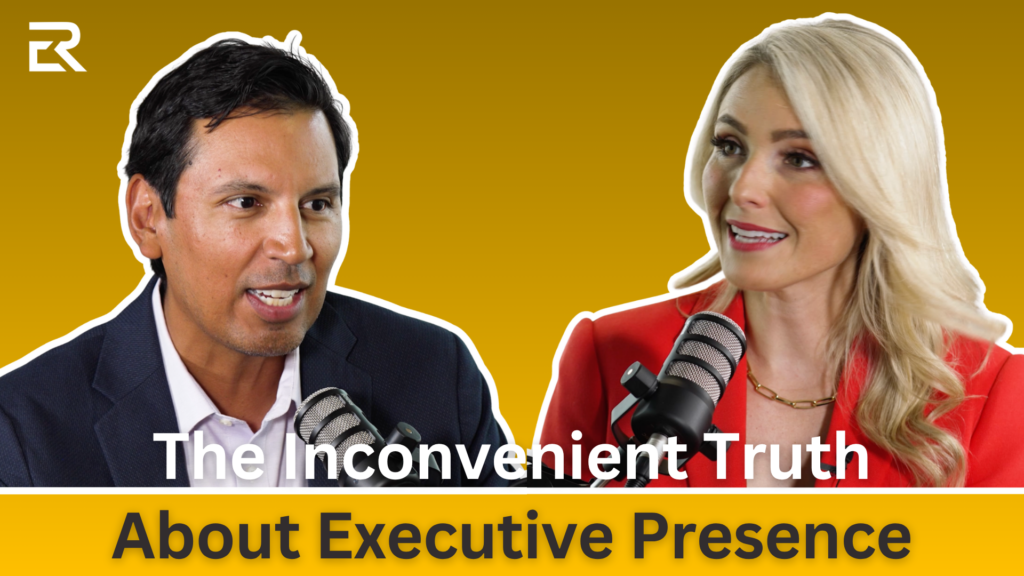
I have been sitting with this for two days. The line came from Kristy Siefkin, an executive coach, keynote speaker, and recovering broadcast journalist who spent 15 years at CBS, ABC, and NBC before she started coaching the leaders who now sit across from her. She’s the guest on this week’s episode of Future of Human Experience. And the whole conversation circled a question that almost no one is asking out loud yet:
What is executive presence, really? And why does the standard playbook for building it quietly fail so many of the leaders who try to use it?
WHAT MOST PEOPLE THINK EXECUTIVE PRESENCE IS
Ask ten leaders to define executive presence, and you’ll get some version of the same answer. Charisma. Authority. A big presence in the room. The ability to walk in and command attention.
That’s not wrong. It is incomplete in a way that proves costly. Because when leaders try to build presence by mimicking those traits, two things happen.
First, the trait-mimicking version of executive presence is unfairly judged. Kristy was direct about this: talent organizations have studied the data, and women and people of color are held to a higher standard of executive presence than their peers. When they adopt the traits that a traditional male executive exhibits — assertive, demanding, authoritative — they are often penalized for it. “Pushy.” “Troublesome.” “A problem.”
Second, even for the leaders for whom the trait-mimicking version works, it tends to break down at exactly the moment leadership matters most: in a room that is anxious, uncertain, or grieving. A version of executive presence built on volume and posture does not steady a panicked team.
WHAT EXECUTIVE PRESENCE ACTUALLY IS
Here is the redefinition Kristy gave me. It is the part of the conversation I want every leader I know to hear.
Executive presence is your ability to operate at the highest level through clear communication, emotional management, the capacity to meet your team where they are, and the discipline to solve problems with the group’s needs ahead of your own.
Underneath that, three pillars run through every study she has seen on what builds trust in a leader:
1. Competence. Can you actually do this job?
2. Care. Are you considering the needs of the person in front of you, not just your own?
3. Candor. Can you say the hard thing, even when it’s painful?
Notice what is not on that list. Volume is not on that list. Posture is not on that list. “Looking executive” is not on that list.
The leaders who actually have executive presence build it with their own voice, values, and brand. They dialed up the traits that work in any room — clarity, calm under conflict, the ability to use human language and storytelling — and they stopped trying to mimic the traits that worked for someone else.
THE QUIET COST OF AI IN ALL OF THIS
While we were talking, Kristy gave me a data point I have to share — because it connects.
About 80% of your people can already tell when you use AI to write your communication. About 50% of them lose trust in you as a leader the moment they catch it. About 40% lose trust in your brand as a whole.
Now layer that on top of the executive-presence frame. If presence is built on competence, care, and candor — what does it cost you when every email you send carries the unmistakable signal that a model wrote it? You may be sending perfectly crafted messages. You are also quietly handing your team evidence that you didn’t care enough to write it yourself.
Executive presence is not a writing style. It is the signal under the writing that says: a human did this, and the human did it for you.
THE SMALLEST SHIFT YOU CAN MAKE TOMORROW
Kristy started our conversation with the smallest possible practical example, and I want to leave it with you here because it is the kind of shift you can apply in your next Zoom call.
Sit at the edge of your chair. Engage your core. Look tall.
That is presence in three sentences. Not because the posture itself is magic, but because the posture forces you to be present — engaged with the room rather than slumped behind it.
Now layer that with the bigger frame: clear communication, calm in conflict, care for the room before yourself, candor when it counts. That is the redefinition.
THE ONE QUESTION
I want to leave you with the question Kristy gave me, because it is the operating principle behind everything she said about presence.
Before your next high-stakes conversation — a town hall, a 1:1, a board update, an email to a leader you’ve been avoiding — ask yourself this:
“Am I communicating in a way that protects me and makes me look good? Or am I communicating in a way that is genuinely helpful to the person I’m trying to persuade?”
If you sit with that question for thirty seconds before you hit send, you will change the next thing you write. And the leaders who consistently change the next thing they write are the leaders other people quietly call “executive.”
If you watch the full conversation, you will learn something new about being an executive. That is the promise.
Listen on Apple, Spotify, or your favorite player. Watch on YouTube. Wherever you find it — share it with the leader on your team who has ever been told to “work on their executive presence” and didn’t know what to do with that feedback. This is what to do with it.
If you want a version of this conversation inside your own leadership team — keynote, executive workshop, off-site session, or a calibration-cycle prep conversation with your talent team — that is exactly the kind of room I want to be in. Reach out at ericjrodriguez.com.