
On Thursday of this week, the FIFA World Cup will open in three countries at once. The United States. Mexico. Canada. The first tournament has forty-eight teams. The most globally-distributed sporting event in human history.
Most of the conversation around the tournament will be about the matches. Who wins, who is favored, which star delivers in the moment. Worth watching. But for everything sport does between those moments — for the culture it shapes, for the community it builds, for the workforce of human beings it actually moves around the planet to make any of this possible — we tend to be quieter.
I want to be louder about that this week.
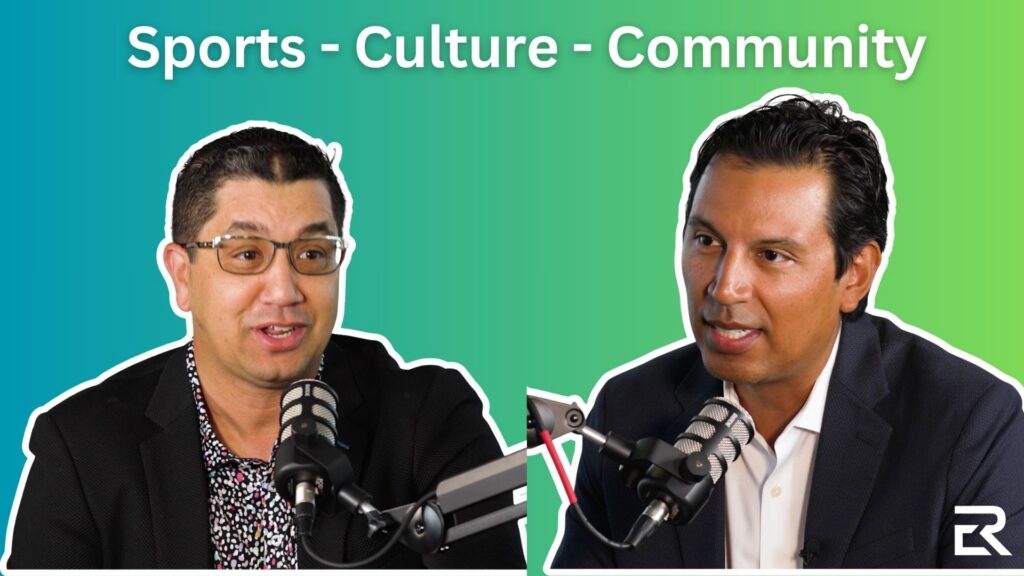
My friend Manny Colon is the Director of Minor League Operations for the Athletics — formerly the Oakland Athletics, now the Las Vegas Athletics. Before this, he spent nineteen years with the Miami Marlins. He has a World Series ring from 2003. He is also a volunteer with the Miracle League of Arizona, a place I want to tell you about before we finish. He is the guest on this week’s Future of Human Experience.
And the entire conversation circled a frame I think is worth bringing into your week as the World Cup begins:
Sport doesn’t just entertain. Sport globalizes a workforce, shapes a culture, and builds the community around it. One person at a time.
WHAT GLOBAL ACTUALLY LOOKS LIKE INSIDE A SPORT
Manny manages 270 players and coaches across five minor-league affiliates plus an academy in the Dominican Republic. Vegas. Midland, Texas. Lansing, Michigan. Stockton, California. Mesa, Arizona. La Victoria, Dominican Republic.
Inside that system, his staff and players come from seventeen countries. Forty-four percent of minor league baseball players are Latino. About thirty-six percent is Dominican alone. The Athletics’ big-league roster currently has three Japanese players, three Taiwanese players, a Taiwanese athletic trainer, and a Korean athletic trainer. Five seasons ago, they had one Japanese player.
Manny’s operational philosophy fits in one sentence. “What you never want to lose is the touch of the human element.”
What that means in his department: housing logistics, pay accuracy, CBA compliance, transportation, and English classes for the players coming from abroad. The English classes are not a benefit. They are infrastructure for a global game. “You guys are going to become major leaguers one day,” Manny tells them. “When you get interviewed after a game, it’ll be really cool to be able to answer in English.”
When I asked him what discipline sat under all of it, he said one word three times.
“Empathy. Empathy. Empathy is huge. Put yourself in that person’s position. How would you feel if I just sent you to the Czech Republic? You don’t know their language. You don’t know anything. How are you going to move around? That’s what they’re doing.”
That is what sport-as-global-workforce actually looks like behind the broadcast booth. Less spectacle, more logistics. Less stage, more empathy as an operating discipline.
HOW SPORT SHAPES CULTURE
Manny made a point in the middle of our conversation that I have been turning over for two days. He said that baseball is already global within the product. The question now is reaching the audiences of where those people are from.
That is the same arc every cultural industry follows. The product crosses the border first. The conversation follows. The community is built last.
He referenced the WBC. He referenced MLB’s London series. He referenced what the NBA pioneered with the Dream Team era. And we talked about the Bad Bunny halftime show — about how an island of 3.1 million people keeps producing music, entertainment, and athletic talent that the rest of the world picks up and runs with.
Manny wrote a blog after the Super Bowl about what the halftime show meant to him. He told me that at the end, when Bad Bunny named each Latin American country one by one, he remembered something his late father had taught him. “America is not the United States. America is Canada, the United States, South America, and Central America. It’s everything.” The line landed on a kitchen table in Tennessee long before it landed on a stage in Las Vegas.
I told Manny I knew the story personally. I was born in Houston, the son of immigrants. We moved to Ecuador when I was eleven. I learned what it was like to be the kid who wasn’t American enough in America and wasn’t Ecuadorian enough in Ecuador. Dual belonging gives you a skill that the rest of the workforce is now urgently trying to learn. We were doing empathy across difference before anyone called it that.
Sport is one of the places where the story gets told most clearly. The World Cup, the WBC, the Olympics, the NBA’s global rosters, these are the venues where the workforce of the planet shows up under one banner, briefly, and the rest of us watch and remember that the world is a lot bigger than the country we happen to live in.
WHERE SPORT BECOMES COMMUNITY
Before we ended the conversation, Manny told me about a small diamond in North Scottsdale called the Miracle League of Arizona, where special-needs kids and adults get to play baseball.
“I make sure I wear my sunglasses because you’ll get a little tear when you’re there.”
If the World Cup is the largest expression of what sport builds globally, the Miracle League is the smallest and most concentrated expression of what sport builds locally. Same thing, different scale. A field. A glove. A community that says, “Come play with us.”
That is what sport actually does. It is what it has always done.
WHAT TO TAKE INTO YOUR WEEK
Watch the World Cup. Cheer for whichever team or country has your heart. And in between matches, if you have a free Saturday morning this summer, go find a Little League game in your neighborhood. Or a Miracle League game. Or a youth soccer pick-up. Or whatever the version of “local diamond” is in your community.
Sport, at its largest scale, will be on every screen for the next month. Sport at its truest scale is in places nobody is filming.
Listen to the full conversation with Manny Colon on Future of Human Experience this week — wherever you get your podcasts, or on YouTube. And if you live in the Phoenix area and want to get involved in the Miracle League of Arizona, Manny is the easiest possible person to ask. He’ll be there with his sunglasses on.
Enjoy the tournament.