
A year ago, I couldn’t have given this talk.
I had the framework. I had been writing about the asymmetry between how quickly technology scales and how slowly human capacity keeps up. I had been having quiet conversations with leaders across healthcare, tech, education, and biotech for months. The intellectual architecture was there.
The personal weight wasn’t.
Three weeks ago, I opened the SCRS West Innovation Summit 2026 with the keynote I had finally been able to give. My parents were in the front row.
Why I’m Writing About This
The Society for Clinical Research Sites runs an annual summit that brings together about 300 industry leaders. This year, SCRS deliberately put the humans within the technology at the center of the conversation, and they invited me to open the summit.
I am writing this recap not because the talk was relevant only to clinical research, but because what I said at SCRS is the same argument I find myself making across every industry I work with. The vocabulary differs. The platforms differ. The asymmetry doesn’t.
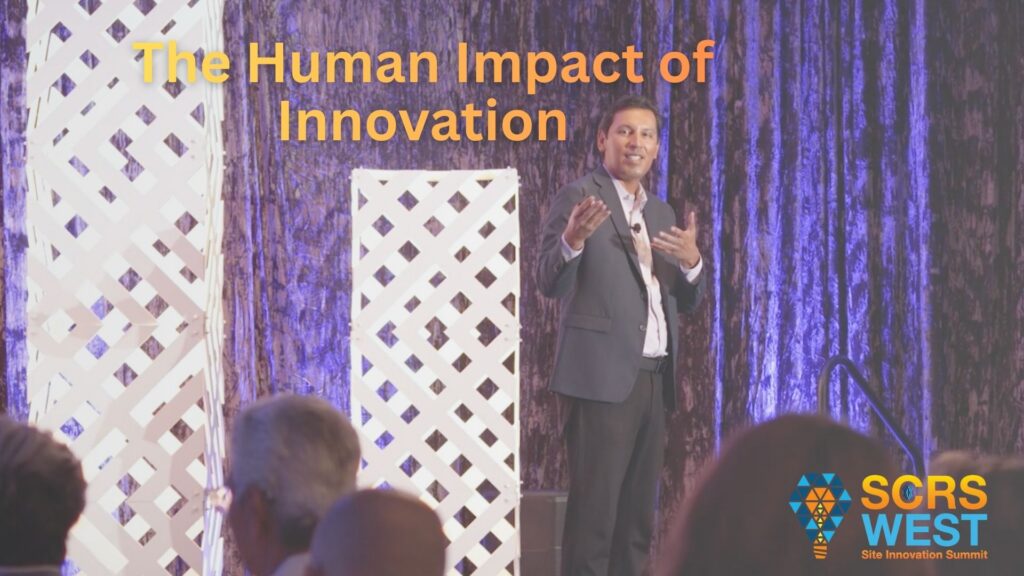
“90 seconds from ‘The Human Advantage in Innovation’ — SCRS West 2026 Opening Keynote”
The Core Argument
The talk was built around one sentence: technology compounds, humans don’t.
For the last several years, organizations in nearly every sector have been asked to absorb wave after wave of change — new platforms, AI tools, integrations, customer-facing systems, internal restructures. Most of the public conversation has focused on the technology. Very little of it has focused on the humans responsible for absorbing it.
Innovation without a human strategy is not progress. It is pressure with a new name.
The keynote walked through what has been landing on people in the last 36 months, why the conventional responses (faster training, better change management) are misdiagnosing the problem, and what an actually different approach looks like, a framework built around three operational moves: Adapt, Connect, Translate.
What Made the Room Different
I have given many keynotes. This one was different.
The room sat with a quiet I have rarely felt at an industry conference. There was a beat, I want to be careful about how I describe this, where you could feel the audience recognize, in real time, that what was being said about their experience was true. That they had been carrying something no one had named for them.
The standing applause at the close was not the kind that comes from energy. It was the kind that comes from being seen.
Three Things You Can Use This Week
Three operational moves any leader in any industry can start on immediately:
Adapt. Build absorptive capacity in your team before the next change arrives. Cross-training. Slack time. A quarterly review of “what landed on us that we did not plan for.” Do not wait until the team is already drowning.
Connect. The people doing the work know what the work actually costs. Before you say yes to the next tool, the next initiative, the next pilot — ask the people closest to the work what it would actually take to absorb it. If you do not know the answer, you are not ready to say yes.
Translate. Make the human cost of innovation visible to those who do not bear it directly. Build a one-page visual you can hold up in any leadership meeting, three columns: what landed last quarter, what is landing this quarter, what is queued for next quarter. The conversation changes when the absorption load is named.
And one thing every leader can do tomorrow morning: walk up to one person on your team and ask them what they are carrying that you have not asked about. Then just listen.
The Personal Layer
The reason I could give this talk a year after I couldn’t is that the last 12 months changed my understanding of what we mean by “innovation.”
My family’s experience over the last year, surgeries, recovery, the long, slow work of building back, was made possible by quiet work done by people most of us will never meet. People in labs. People in clinics. People running the systems that make modern care possible. People who innovate not because innovation is a strategy, but because it is the human thing to do.
My family is one example. There are countless others. Every industry has its own version of this story.
Bring This Keynote to Your Stage
If you are leading a conference, an offsite, a leadership summit, or a team retreat in 2026 or 2027, and the human side of innovation is the conversation your audience needs, I would be honored to bring this talk to your stage.
The talk adapts across industries. The asymmetry between scaling technology and scaling human capacity is showing up in healthcare, biotech, technology, education, financial services, manufacturing, and government. The vocabulary differs. The work doesn’t.