
My parents left home for people who did not exist yet.
That’s the sentence I keep coming back to. Not the courage it took to leave, though there was plenty. Not the years of starting over, though there were plenty of those, too. The math of it. They walked away from their parents, their community, the streets they knew without thinking, and they did it as a bet on children they had never met. Children who were, at that point, only an idea they carried with them.
I was one of those children. I was born into the payoff of a wager I never saw placed.
Growing up first-generation gives you a kind of double vision. You live inside the country your parents chose, and at the same time, you can see it the way they saw it from the outside: as a promise. Not a guarantee. A promise. There’s a difference, and my family has always understood the difference. A guarantee asks nothing of you. A promise asks for everything.
So when people talk about the American Dream like it’s a slogan, I get a little quiet. For my family, it was never a slogan. It was a decision made by two people who gave up everything familiar so that someone down the line could have choices they never had. The distance between my parents’ childhood and my kids’ childhood is one generation. That’s it. One. I don’t know a stronger argument than that the promise is real.
And yet.
This is the part where I’m supposed to either wave the flag or burn it, because that’s how we talk about America now. I’m not going to do either. I love this country the way you love anything real: with my eyes open. The gap between what America promises and what it delivers is not news to anyone in my family. We’ve lived on both sides of that gap.
But here’s what I’ve come to believe. The imperfection is not a reason to give up on the promise. The imperfection is the assignment. You don’t renovate a house you’ve stopped believing in. Criticism, the honest kind, the kind that shows up with tools, is a form of love. The people who worked to close that gap over 250 years didn’t do it because America was already good enough. They did it because it wasn’t, and they believed it could be. Loving an imperfect country and rolling up your sleeves anyway is the whole tradition.
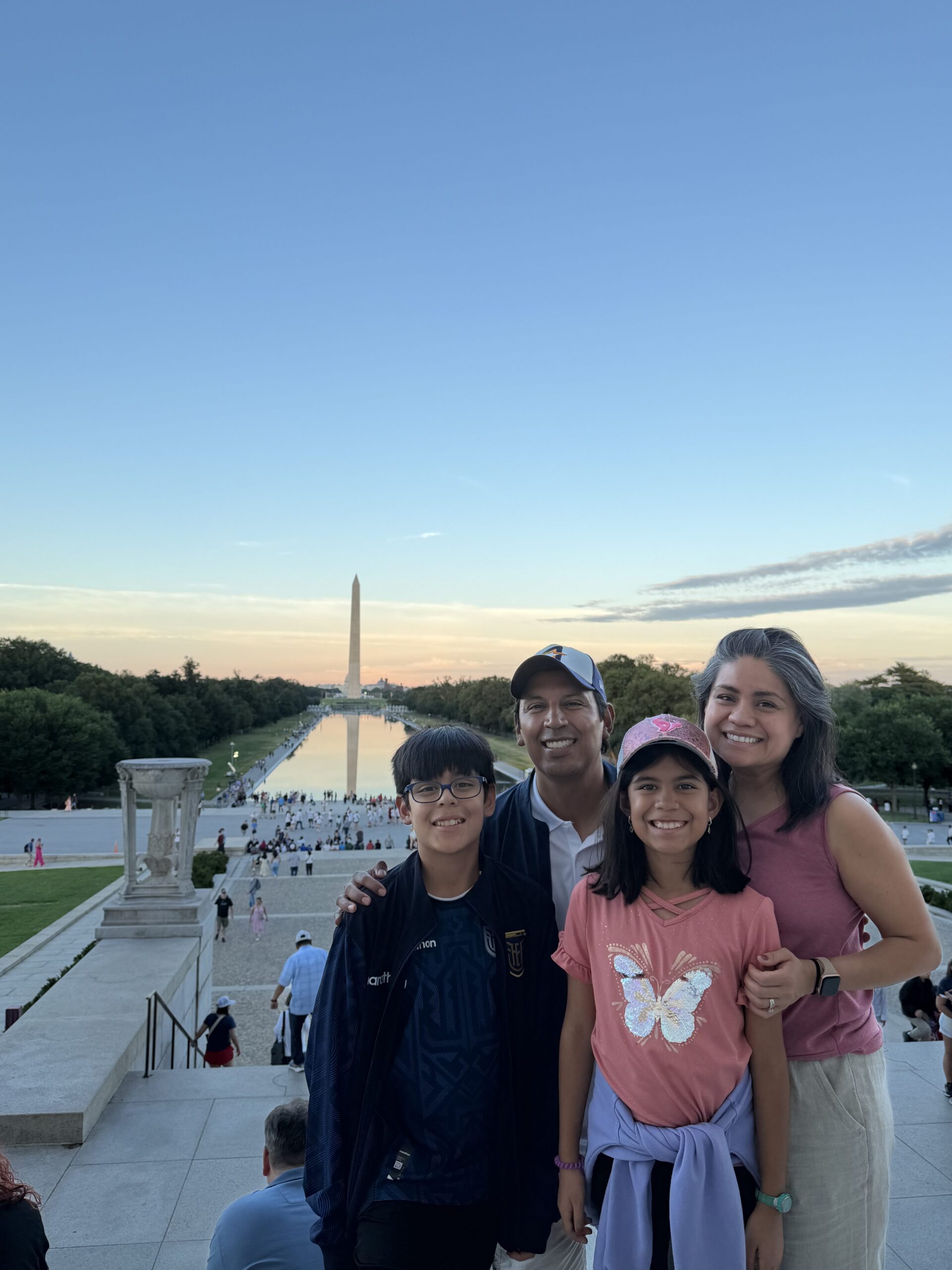
I got to watch this up close recently. My wife and I took our kids to Washington, D.C. for the first time. It was our third trip; every time we go, the two of us come home refueled, ready to be of more use to people. This time, we wanted the kids to stand in front of the history itself. The memorials. The words carved in stone by people who were handed an imperfect country and chose to work on it anyway.
Here’s what got me. They didn’t come home with facts. They came home inspired, already asking when we can go back. And somewhere on that trip, they picked up the idea I most wanted them to have, one they’re finally old enough to hold: this history isn’t finished, and leading, helping, and living out the ideals we talk about at our kitchen table is a job that will eventually have their names on it.
That’s the inheritance. My parents paid for it. My kids get to walk through the monuments feeling like the story includes them. My job is to make sure it stays that way for the kids coming after them.
That question, what we owe the people coming next, has quietly taken over my life. It’s why I host The Future of Human Experience, where I sit with people who are thinking hard about what it will mean to be human in the decades ahead. And it’s why the work I do comes down to one thing: helping others build the Human Era, a future where our technology, our institutions, and our choices actually serve people instead of the other way around. It took me years to notice the through-line. My parents were the original futurists in my life. They made a decision on behalf of a future they could barely see, for people they hadn’t met. Everything I do is a smaller version of that same move.
Which brings me to this birthday.
Two hundred and fifty years is a strange number to celebrate, because nobody who started this project got to see even a fraction of it. The founders never met Lincoln. Lincoln never met the marchers in Selma. The marchers never met my parents, standing in line at a consulate with their whole future folded into a set of documents. Every generation inherited a promise from strangers and had to decide, on their watch, whether to keep it.
Now it’s our watch.
So here’s how I’m treating the 250th. Not a finish line. A handoff. The fireworks are fine. Enjoy the fireworks. But somewhere between the cookout and the grand finale, I’d ask you to sit with one question, the same one my parents answered with their lives:
What are you doing for people you haven’t met yet?
It doesn’t have to be dramatic. Mentor somebody. Build something that outlasts you. Fix one broken thing in your community and don’t sign your name to it. The best of this country was built by people making sacrifices for strangers they would never meet.
Two hundred and fifty years in, it’s our turn.
My parents bet everything on people who didn’t exist yet. I exist. My kids exist. The promise held.
Let’s make sure it holds for the next ones.