
Somebody is working today.
The refinery where I started my career doesn’t close for Labor Day. Neither does the fab. Neither does the hospital, the airport, the distribution center, or the utility. While most of the country is at a lake, someone in a control room is watching a screen, because the process doesn’t care what day it is.
I used to be one of those people. Then I became the engineer who automated the room.
I remember what that actually looked like. A task that had lived in somebody’s hands and somebody’s judgment became a sequence, then a setpoint, then an alarm that only went off when something was wrong. The board that used to need a person watching it all shifted now mostly watched itself. And the operators, who knew things about that unit I could not have found in any drawing, joked about it the way people joke about something they are genuinely unsure of.
For a long time I thought my job was removing work.
It took me years on the business side to understand it differently. Automation does not eliminate value. It relocates it. The only real question is whether anybody in the building notices where it went.
Labor Day did not start as a barbecue. It started as an argument about what work is worth. That argument is open again right now, and it is not the argument anyone thinks it is.
The word everyone is using is wrong
The story we have been told for three years is disruption. Someone builds something in a garage; it comes for your industry; you either adapt or you get run over.
Disruption is almost flattering. At least there is somebody to point to. A startup, a new business model, a competitor coming for your customer.
What is actually happening to most companies is harder to see, because nobody is doing it to you.
Everybody bought the same models. Everybody read the same case studies. Everybody sat through the same conference sessions, including the ones I gave.
And it is working.
Cycle times drop. Cost per unit drops. The efficiency is real, and it shows up on every dashboard in the building. Your dashboard is not lying to you.
That is the problem.
An advantage everyone can buy is not an advantage. It is the floor.
The floor moved for your entire industry, on roughly the same day, at roughly the same price.
You are not indistinguishable yet. You still have brand, trust, distribution, proprietary data, relationships your people spent fifteen years building. All of that is still yours.
What just went generic is the part you were counting on. Being faster. Cheaper. Better run.
When every competitor can produce faster, cheaper, and with fewer errors, operational excellence alone no longer protects your margin. It becomes the price of being in the room. And the gain you worked for does not necessarily stay yours. Competitors catch up, prices adjust, and some of it gets handed to the customer, which is excellent news for the customer.
That is the real cost. Not your headcount.
Your margin.
And nobody is doing it to you. No disruptor to point at, no competitor to name, no villain in the story. That is exactly why no alarm is going off.
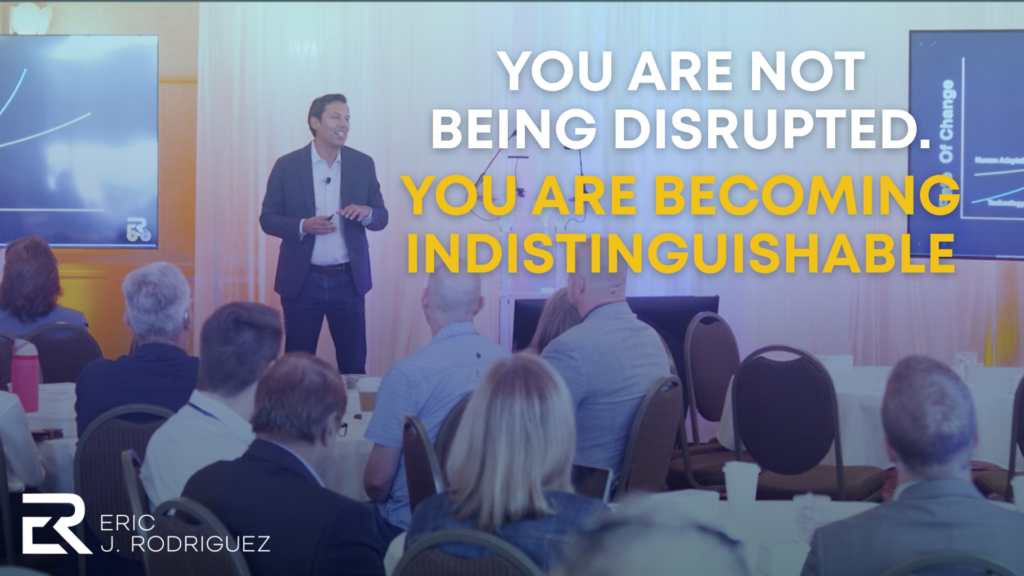
You are not being replaced. You are not being disrupted.
You are becoming indistinguishable.
The gap is measurable
PwC’s 2026 study of 1,217 senior executives across 25 sectors found that 74 percent of AI’s economic value is being captured by 20 percent of organizations.
The interesting part is what separates that 20 percent, because it is not simply how much AI they bought. Those leaders were two to three times more likely to use AI to pursue growth opportunities, and twice as likely to redesign how work gets done rather than adding AI tools on top of it. PwC’s own conclusion is that chasing growth predicted AI-driven financial performance more strongly than efficiency gains did.
Here is the plainest way I can say it.
Most organizations are running AI as an efficiency program. Leaders treat efficiency as the beginning of the strategy rather than the end.
A floor is not a ceiling
Everything you bought raised the floor. It was supposed to. That is what you paid for.
But nobody sells the ceiling. No vendor sells it, no platform, no consultant with a deck. You cannot procure it, and neither can your competitor.
The ceiling is the part nobody can buy for you.
And I want to be precise here, because this is where most people get the answer wrong in a way that feels good and does nothing.
The answer is not “be more human.” Everyone is human. If being human were the differentiator, we would all be differentiated, and we would be having the same conversation one level up.
The advantage is not that your people are human. The advantage is what you decide to do with the capacity the machine just handed you.
Every time technology makes something cheaper, it hands something back. Time, attention, money, capacity. It arrives whether you planned for it or not, which means you are spending it right now whether you decided to or not.
Most organizations bank the dividend. Banking sounds responsible, and it is easy to see why. It shows up immediately as a cost line that got smaller, a role you did not have to backfill, a quarter that looked fine. Nobody is ever criticized for that.
The other option is to put it back to work. Into an experience worth paying more for. Into people who get deeper instead of thinner. Into markets that used to be too expensive to serve at all.
That last one is the whole game, because it turns a cost story into a growth story, and growth is what PwC found on the other side of the gap.
The person in the control room
Somebody is working today.
Labor Day was built out of a fight over what work is worth. That fight is not over. In this era it has taken a different shape, and the question now is not what work is worth. It is this:
When technology creates more value out of less human effort, where does that value go?
To shareholders. To customers as lower prices. To employees as better work. To new products, new markets, more capacity, more time. Every one of those is a legitimate answer, and every one of them is a choice.
Most organizations are making that choice right now without ever putting it on an agenda.
In five years, two companies in your industry will have bought the same tools, in the same year, at the same price, and will have landed somewhere completely different. The tools will not explain it. The tools were identical.
The difference will be what each of them decided to do with what those tools gave back, and whether anyone was awake when the decision was made.
AI raised your floor. Everybody’s floor.
Go set the ceiling.
Eric J. Rodriguez is an AI keynote speaker who spent eight years building factory automation at Shell and Intel, then nine years on Intel’s business side watching what happened after the technology worked. His work asks a simple question: when technology stops being the hard part, where does the value go, and who decides?
If your leadership team has not decided where your technology dividend should go, that is a conversation worth having before the market decides for you.