
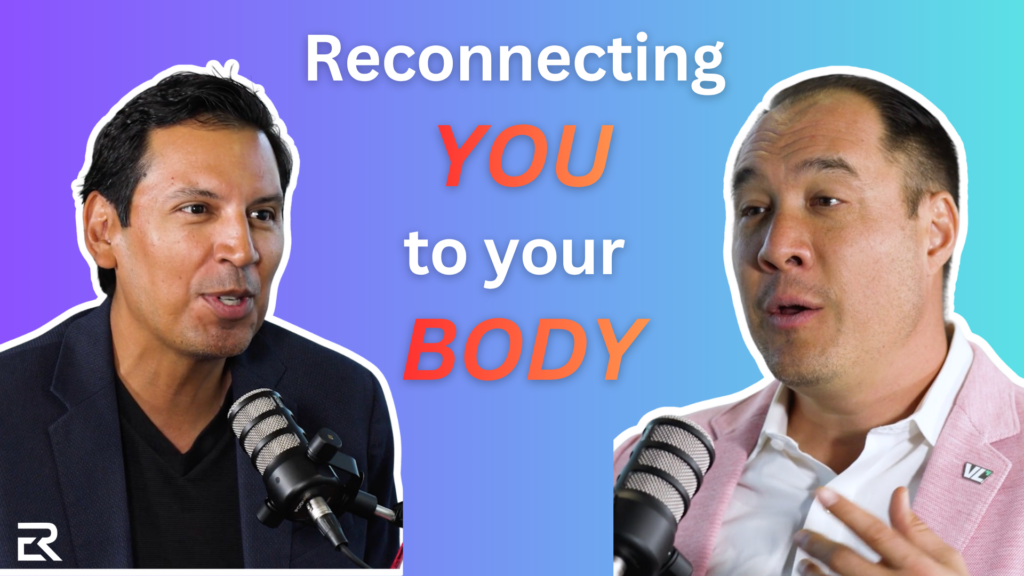
Almost everyone walking around in 2026 has a wearable. A sleep score. A heart-rate variability number. A vague sense that something is off, and a watch that keeps telling them they slept 87% well.
Greg Lim has the cleanest critique of this I have heard.
Greg is the co-founder of Well Beings, a startup building a universal health record for consumers. He spent seven years as a senior executive at LifeLock — helping take that company public — before turning his attention to what he calls a love note to his parents: a system that actually lets a person own and access their own health information, so they can manage their health instead of being managed by it.
He’s the guest on this week’s Future of Human Experience. And he said something about ten minutes into our conversation that I have not been able to put down.
“The industry has gamified health so much that we’ve actually disconnected people from their bodies.”
Sit with that for a second. We have spent a decade building the most precise consumer-grade biometric measurement infrastructure in human history. Your watch knows your resting heart rate to the beat. Your ring knows the temperature of your finger overnight. Your scale knows your body fat composition. And the net result — for a lot of people — is that they trust the gadget more than they trust the body it is supposedly measuring.
WHY THE 7-MINUTE GAP MATTERS
Greg started Well Beings because of his parents. His mother spent years carrying a folder of paper medical records from specialist to specialist because no one was looking at her as a whole person. Her neurologist looked at her brain. Her endocrinologist looked at her blood markers. The diagnosis that finally explained what was happening took years longer than it should have. His father had a second stroke and was discharged from the hospital while he was still actively stroking.
Greg’s read on the system: “Healthcare professionals only get to know you for those seven minutes you’re in the office. And that one test you took. So we’re completely ignoring the other 364 days when you’re not at the doctor’s office. But that’s your life. That’s most of your health.”
Seven minutes against 364 days. That is the gap every benefits leader, chief medical officer, and HR team should be thinking about right now.
THE BANK ACCOUNT ANALOGY
When I asked Greg how he thinks about consumer ownership of health data, he gave me an analogy that I want every leader making a benefits decision this quarter to sit with.
“Imagine if I were to go to you and say, Eric, I’m going to take away access to all of your bank accounts, all of your credit cards, but I want you to make really sound financial decisions. You’d be like, “That’s crazy. But that’s exactly what we’ve normalized in healthcare.”
Every other aspect of our lives — our money, our communications, our schedules, our locations — we own and access our own data. Health, the area where it matters most and where the decisions are highest stakes, is the area where we don’t.
I asked him about my own father’s recent journey. I had a conversation with one of his doctors where I asked, “What is the next best step for my dad?” And the answer was “It depends on what the insurance says.” I had to push back. “I am asking for your medical opinion. Forget the money.” The doctor struggled with the answer. Not because he didn’t care. Because the system has trained him to think with the insurance company in the room.
Greg’s answer to this is not to fight the system. It’s to build the consumer-side complement to it. A patient who walks into the doctor’s office with a clear understanding of what their data has been doing, their wearable, their labs, their prescriptions, their visit history across hospital systems, all in one place, gives the doctor back the time they spent fishing for that information. It gives both sides the chance to actually be human for a few minutes.
THE PREMIUM EXPERIENCE IS THE HUMAN EXPERIENCE
I have been saying this line for two years now, and Greg’s conversation gave me the cleanest application of it I have heard.
The Ubers that survive automation are the ones that feel like a limousine. The banks that survive the rise of fintech are the ones whose advisors know your name and your retirement plan. The call centers that survive AI are the ones where the human you finally get on the line was trained to do something the bot cannot.
The healthcare experiences that survive the next decade are going to be the ones where the human side of it, the relationship between you and your doctor, the conversation between you and your spouse about a diagnosis, the moment when a family caregiver walks into an appointment armed with the same data the medical team has, is the part the system protects, not the part the system squeezes.
Greg has built the consumer-side scaffolding for that future. The rest of us, leaders, employers, parents, and caregivers, get to decide whether we use it.
ONE MORE FRAMEWORK WORTH STEALING
Before we ended the conversation, Greg shared the communication framework Well Beings uses with its users. Three steps. I want you to steal it for every conversation you have with your own people.
1. What we see. (“Over the last five days, your deep sleep has been compressed, and your heart rate variability has decreased.”)
2. Why do we see it? (“That’s usually a sign of your body shifting into fight-or-flight mode. Here’s what’s been happening in your activity, sleep, and work.”)
3. What you can do about it. (“Here are two specific things you can try.”)
That structure works for a wearable insight. It also works for a performance conversation, a strategic review, a difficult family talk, and a board update. Lift it.
Listen to the full conversation with Greg Lim on Future of Human Experience — wherever you get your podcasts, or on YouTube. And if you lead a benefits team, a wellbeing program, or a chief medical office, this is the episode to share with your peers this week.
If you want to bring a version of this conversation to your leadership team, a keynote, a workshop, a facilitated session on what consumer-grade health actually looks like inside your organization, that’s exactly the kind of room I want to be in. Reach out at ericjrodriguez.com.